Introduction
Biodiversity is the foundation of healthy ecosystems, providing stability, resilience, and essential ecological services. Scientists, ecologists, and biostatisticians use biodiversity measurements to understand how species are distributed across different habitats and geographic regions. Among the three major levels of biodiversity—alpha (α), beta (β), and gamma (γ) diversity—gamma diversity provides the broadest perspective by measuring the total species diversity across an entire landscape or region.
Gamma diversity is a key concept in biostatistics, ecology, environmental science, conservation biology, and microbial ecology. It helps researchers assess regional biodiversity, compare ecosystems, identify biodiversity hotspots, and monitor environmental changes over time.
Whether you are a biology student, ecology researcher, or conservation professional, understanding gamma diversity is essential for interpreting biodiversity patterns at the regional scale. This comprehensive guide explains the concept in a simple, step-by-step manner with formulas, examples, tables, and practical applications.
Why Should You Learn Gamma Diversity?
Imagine visiting three different forests. Each forest contains some unique plant and animal species, while others are common to all three. If you count only the species in one forest, you measure alpha diversity. If you compare how species differ between forests, you measure beta diversity. But if you want to know the total number of unique species across all forests combined, you are measuring gamma diversity.
Gamma diversity helps answer important ecological questions such as:
- How diverse is an entire national park?
- Which region contains the greatest number of species?
- How does habitat destruction affect regional biodiversity?
- Which areas should receive conservation priority?
What is Gamma Diversity?
Definition
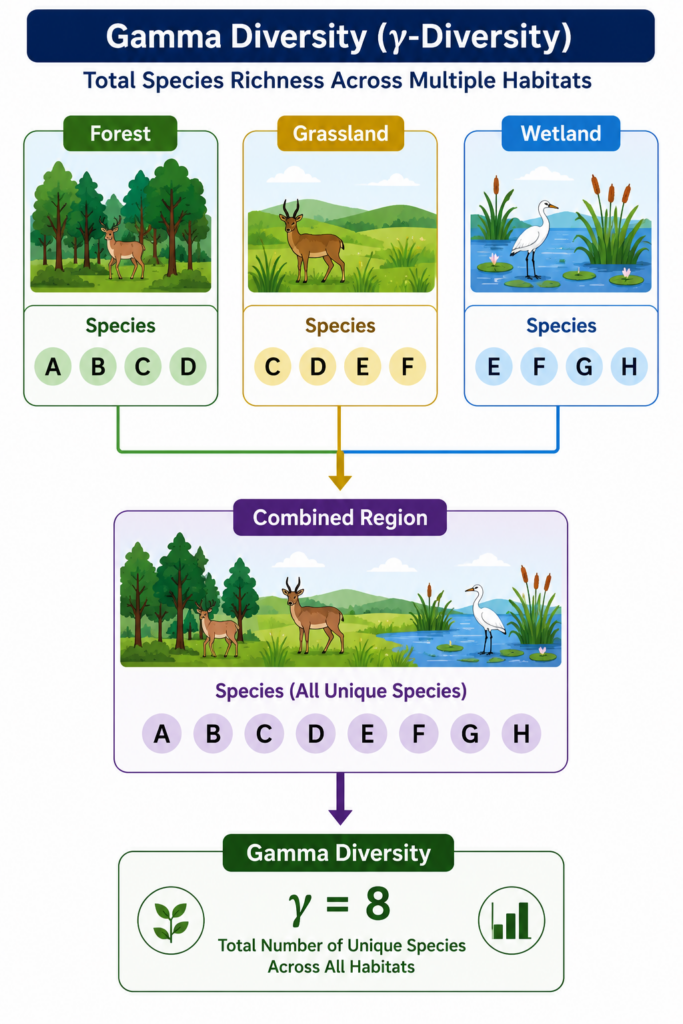
Gamma Diversity (γ-Diversity) is the total number of unique species present across all habitats within a defined geographic region.
Unlike alpha diversity, which measures diversity within a single habitat, gamma diversity combines species from multiple habitats to estimate regional biodiversity.
Simple Definition
Gamma diversity is the total species richness across an entire landscape after removing duplicate species found in different habitats.
Understanding the Three Levels of Biodiversity
Biodiversity is commonly divided into three hierarchical levels.
| Diversity Type | Scale | Measures | Example |
|---|---|---|---|
| Alpha Diversity (α) | Single habitat | Species richness within one community | Species in one forest |
| Beta Diversity (β) | Between habitats | Species turnover among habitats | Difference between two forests |
| Gamma Diversity (γ) | Entire region | Total regional species richness | Species across all forests |
Together, these measures provide a complete picture of biodiversity from local to regional scales.
How Does Gamma Diversity Work?
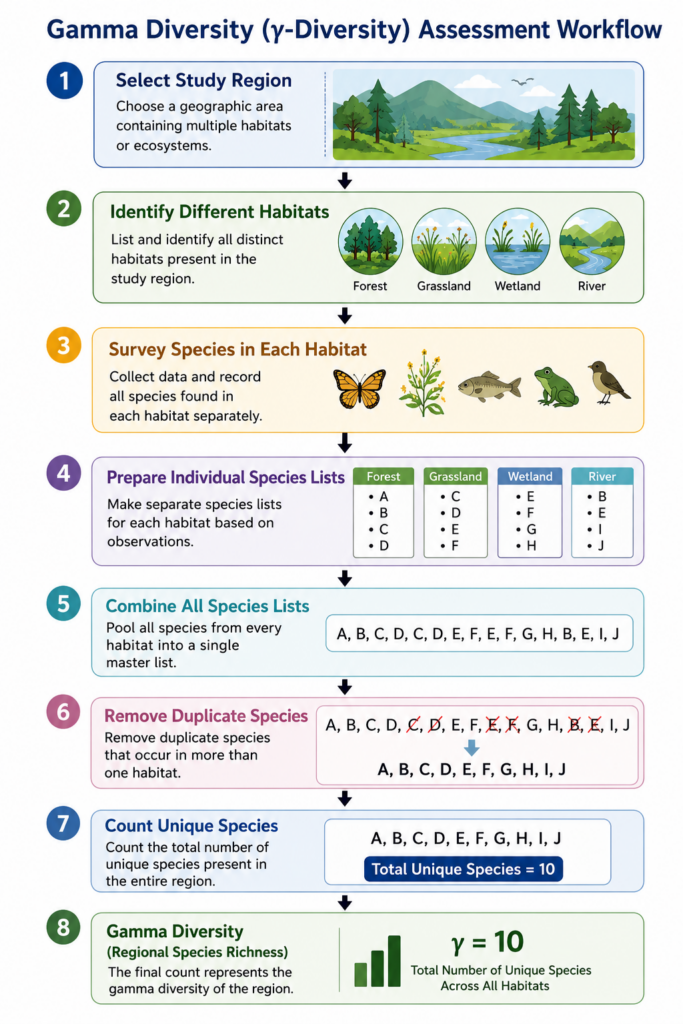
Understanding gamma diversity becomes easier when broken into simple steps.
Step 1: Select a Study Region
Choose a geographic area containing multiple habitats.
Example:
- Tropical Forest
- Grassland
- Wetland
- River Ecosystem
Step 2: Survey Each Habitat
Record every species found in each habitat.
Forest:
- Deer
- Tiger
- Monkey
- Peacock
Grassland:
- Deer
- Fox
- Rabbit
- Peacock
Wetland:
- Frog
- Fish
- Heron
- Duck
Step 3: Combine All Species Lists
Merge species from every habitat into one master list.
Step 4: Remove Duplicate Species
Species occurring in multiple habitats are counted only once.
Step 5: Count Unique Species
The total number of unique species represents Gamma Diversity.
Formula for Gamma Diversity
The simplest calculation is:
Gamma Diversity (γ) = Total Number of Unique Species Across All Habitats
According to Whittaker’s multiplicative model:
γ = α × β
Where:
- γ = Gamma Diversity
- α = Average Alpha Diversity
- β = Beta Diversity
This relationship shows that regional diversity depends on both local diversity and species turnover among habitats.
Worked Example
Suppose researchers survey three habitats.
| Habitat | Species Found |
|---|---|
| Forest | A, B, C, D, E |
| Grassland | C, D, E, F, G |
| Wetland | E, G, H, I |
After combining all habitats, the unique species are:
A, B, C, D, E, F, G, H, I
Gamma Diversity = 9 Species
Interpretation
Although species C, D, E, and G appear in more than one habitat, each species is counted only once when estimating gamma diversity.
Gamma Diversity Assessment Workflow
Relationship Between Alpha, Beta, and Gamma Diversity
Example Dataset
| Habitat | Number of Species |
|---|---|
| Forest | 18 |
| Grassland | 16 |
| Wetland | 12 |
| River | 14 |
After combining all observations:
Total Unique Species = 33
Therefore,
Gamma Diversity = 33
This value represents the biodiversity of the entire study region.
Real-World Applications
Gamma diversity has numerous applications in biological and environmental research.
Conservation Biology
Identifies biodiversity hotspots requiring immediate protection.
Wildlife Ecology
Compares biodiversity among national parks and wildlife sanctuaries.
Forest Ecology
Evaluates tree diversity across forest landscapes.
Agriculture
Measures biodiversity in agricultural ecosystems.
Marine Biology
Studies coral reef biodiversity across coastal regions.
Microbial Ecology
Determines microbial diversity across soil, freshwater, or marine habitats.
Environmental Monitoring
Tracks biodiversity changes caused by pollution, climate change, or habitat fragmentation.
Advantages of Gamma Diversity
- Measures biodiversity at the regional scale.
- Easy to understand and interpret.
- Useful for conservation planning.
- Helps identify biodiversity-rich landscapes.
- Supports ecological monitoring programs.
- Facilitates comparisons among geographic regions.
Limitations
Despite its usefulness, gamma diversity has some limitations.
- Does not consider species abundance.
- Larger study areas generally contain more species.
- Rare species may be missed during sampling.
- Sensitive to sampling effort and survey quality.
- Requires comprehensive field observations across multiple habitats.
Comparison of Alpha, Beta, and Gamma Diversity
| Feature | Alpha Diversity | Beta Diversity | Gamma Diversity |
|---|---|---|---|
| Scale | Local | Between habitats | Regional |
| Focus | Species richness | Species turnover | Total species richness |
| Study Area | One habitat | Multiple habitats | Entire landscape |
| Duplicate Species | Counted | Compared | Counted once |
| Primary Use | Local biodiversity | Habitat comparison | Regional biodiversity |
Common Mistakes Students Make
Many beginners misunderstand gamma diversity. Avoid these common errors:
- Counting duplicate species more than once.
- Confusing species richness with species abundance.
- Assuming larger habitats always have greater biodiversity.
- Ignoring habitat differences during regional surveys.
- Using incomplete species lists.
Key Takeaways
- Gamma diversity measures regional species richness.
- It combines biodiversity from multiple habitats.
- Duplicate species are counted only once.
- It complements alpha and beta diversity.
- It is widely used in ecology, conservation biology, environmental science, and biostatistics.
- Higher gamma diversity usually indicates greater habitat heterogeneity and ecological complexity.
Conclusion
Gamma diversity (γ-diversity) is one of the most important biodiversity measures used in biostatistics and ecology to evaluate the overall species richness of a region. By integrating observations from multiple habitats, it provides a comprehensive picture of regional biodiversity and helps scientists understand ecological patterns beyond individual communities. Whether assessing forest ecosystems, wetlands, coral reefs, agricultural landscapes, or microbial communities, gamma diversity serves as a valuable indicator of ecosystem health and biological richness. Combined with alpha and beta diversity, it forms a powerful framework for biodiversity assessment, conservation planning, and environmental decision-making. As global biodiversity faces increasing threats from habitat loss, climate change, and human activities, understanding and applying gamma diversity has become more important than ever for protecting ecosystems and ensuring sustainable natural resource management.