Introduction
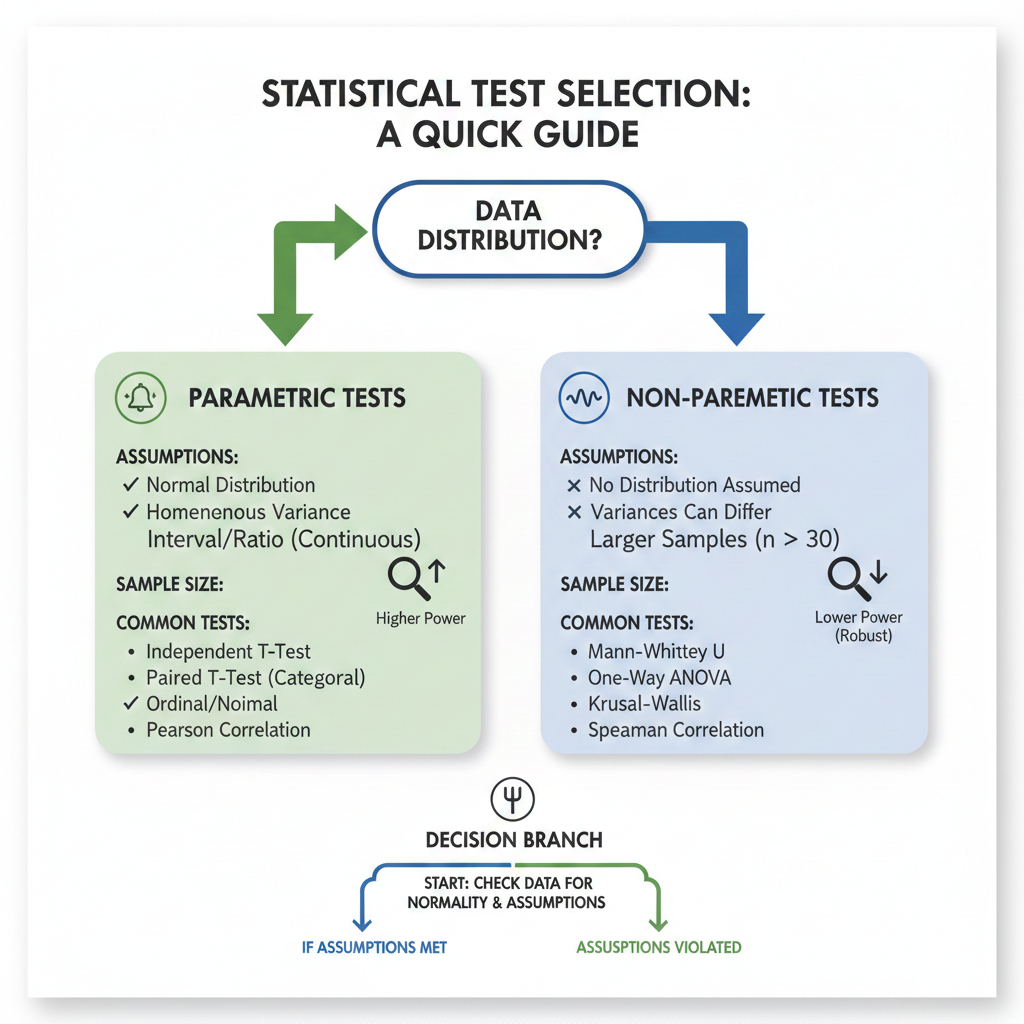
In biostatistics and life science research, data often violate the assumptions required for parametric tests such as the paired t-test. Biological measurements like enzyme activity before and after treatment, clinical scores in patients, or ecological observations across time may not follow a normal distribution. In such situations, non-parametric statistical tests become essential. One of the most widely used non-parametric tests for paired data is the Wilcoxon Signed-Rank Test.
The Wilcoxon Signed-Rank Test is designed to compare two related or paired samples to assess whether their population mean ranks differ. It is especially valuable when sample sizes are small or when data are ordinal or skewed.
What Is the Wilcoxon Signed-Rank Test?
The Wilcoxon Signed-Rank Test is a non-parametric alternative to the paired t-test. It evaluates whether the median difference between paired observations is zero. Instead of relying on raw values, it uses the ranks of differences, making it robust to outliers and non-normal distributions.
This test was proposed by Frank Wilcoxon (1945) and is commonly applied in medical, biological, ecological, and agricultural research.
Key Idea
- Calculate the difference between paired observations
- Rank the absolute differences
- Assign signs (+ or −) based on the direction of change
- Evaluate whether positive and negative ranks differ significantly
When Should You Use the Wilcoxon Signed-Rank Test?
The Wilcoxon Signed-Rank Test is appropriate when:
- Data consist of paired or matched samples
- Differences are not normally distributed
- Sample size is small
- Measurements are ordinal or continuous but skewed
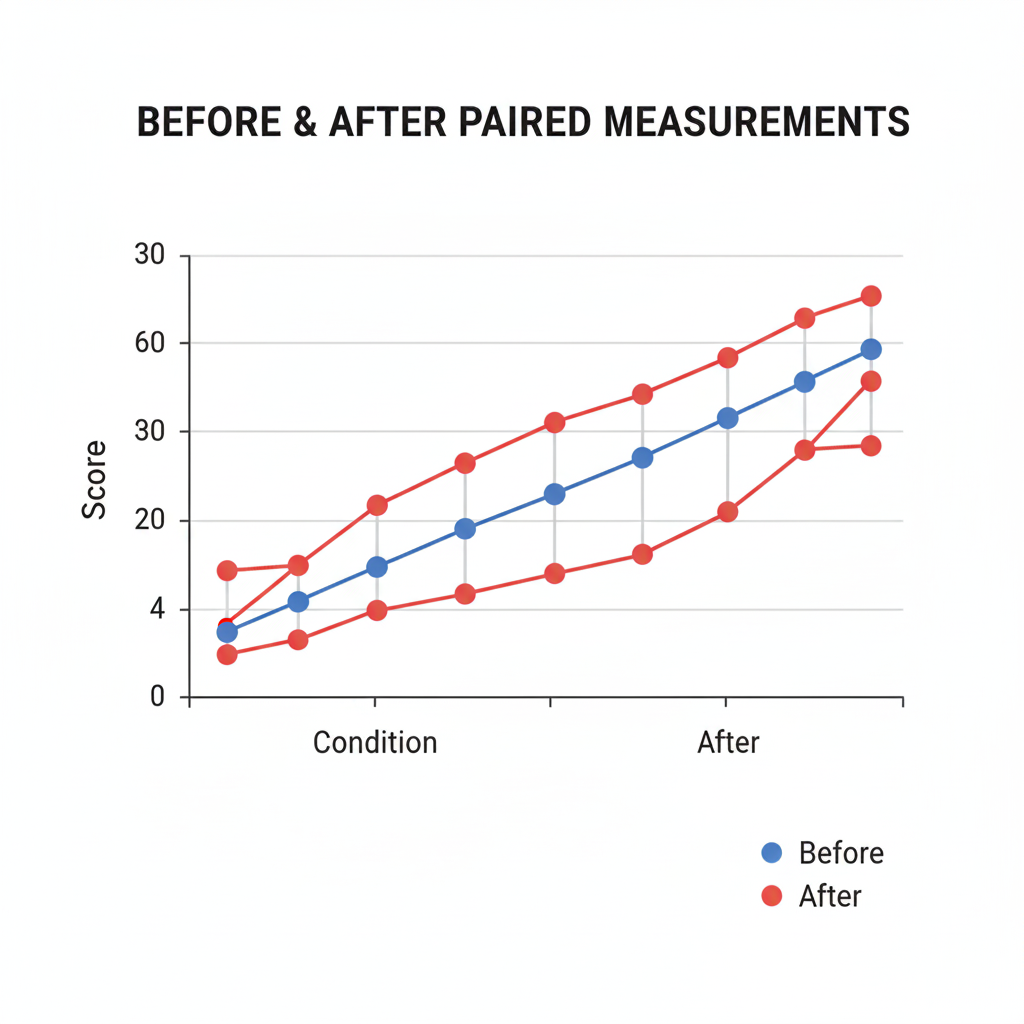
- The study involves before–after comparisons
Common Biostatistical Scenarios
- Pre-treatment vs post-treatment clinical measurements
- Gene expression levels before and after stress
- Growth parameters measured at two time points
- Behavioral scores under two conditions
Assumptions of the Wilcoxon Signed-Rank Test
Although non-parametric, the test has certain assumptions:
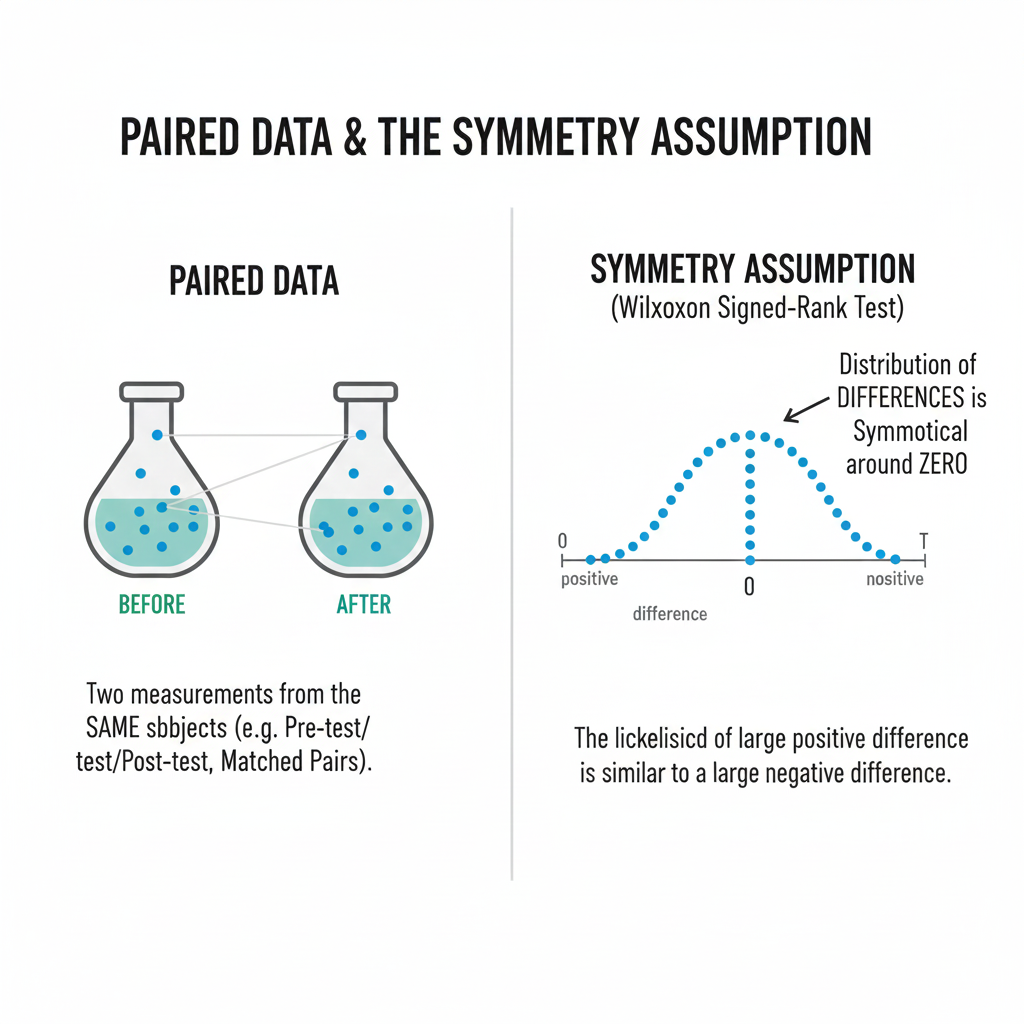
- Data are paired and dependent
- Differences are symmetrically distributed around the median
- Measurement scale is at least ordinal
- Pairs are randomly selected and independent of other pairs
Wilcoxon Signed-Rank Test vs Paired t-Test
| Feature | Wilcoxon Signed-Rank Test | Paired t-Test |
|---|---|---|
| Test type | Non-parametric | Parametric |
| Data distribution | Non-normal | Normal |
| Data scale | Ordinal/Continuous | Continuous |
| Uses ranks | Yes | No |
| Robust to outliers | High | Low |
| Sample size | Small to moderate | Moderate to large |
This comparison highlights why the Wilcoxon Signed-Rank Test is preferred when parametric assumptions are violated.
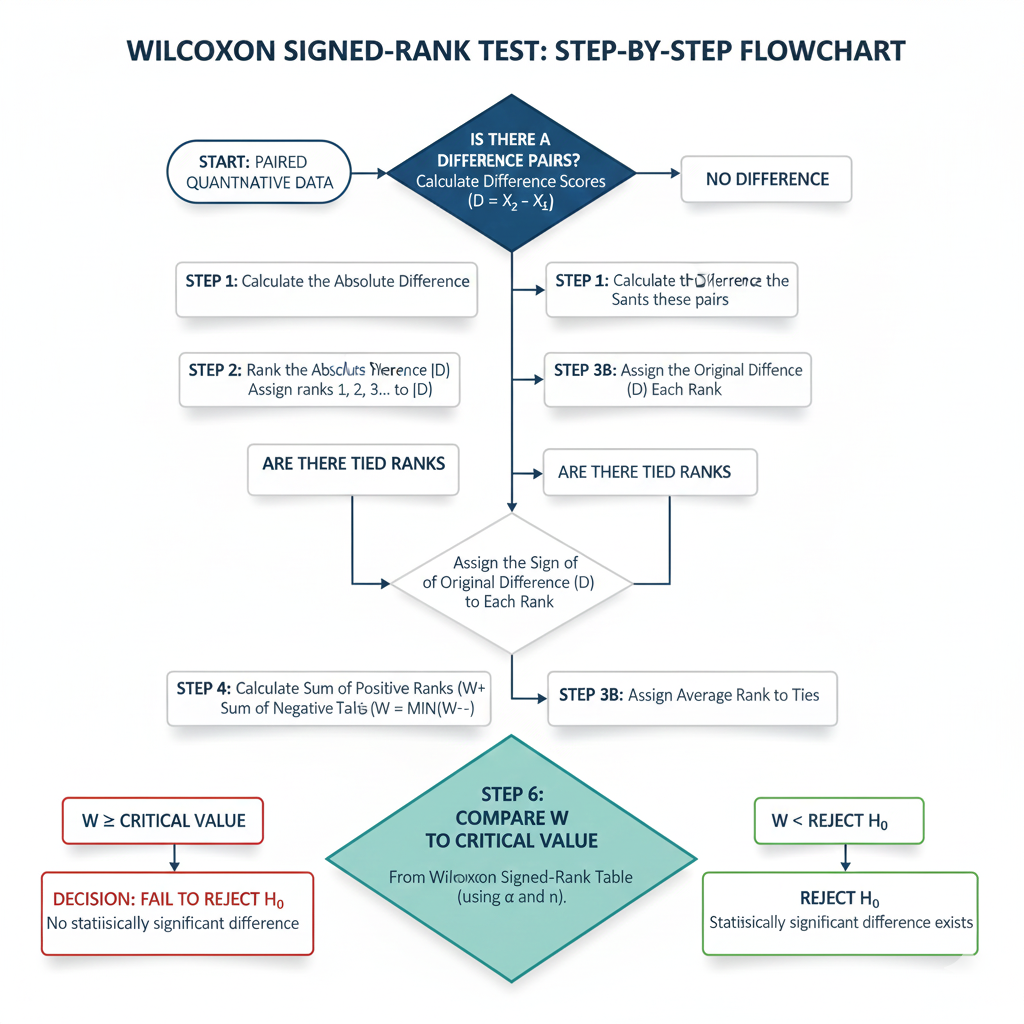
Step-by-Step Procedure of the Wilcoxon Signed-Rank Test
Step 1: Define Hypotheses
- Null hypothesis (H₀): The median difference between paired observations is zero
- Alternative hypothesis (H₁): The median difference is not zero (two-tailed) or greater/less than zero (one-tailed)
Step 2: Calculate Differences
Subtract one condition from the other for each pair.
Step 3: Remove Zero Differences
Any pair with zero difference is excluded from analysis.
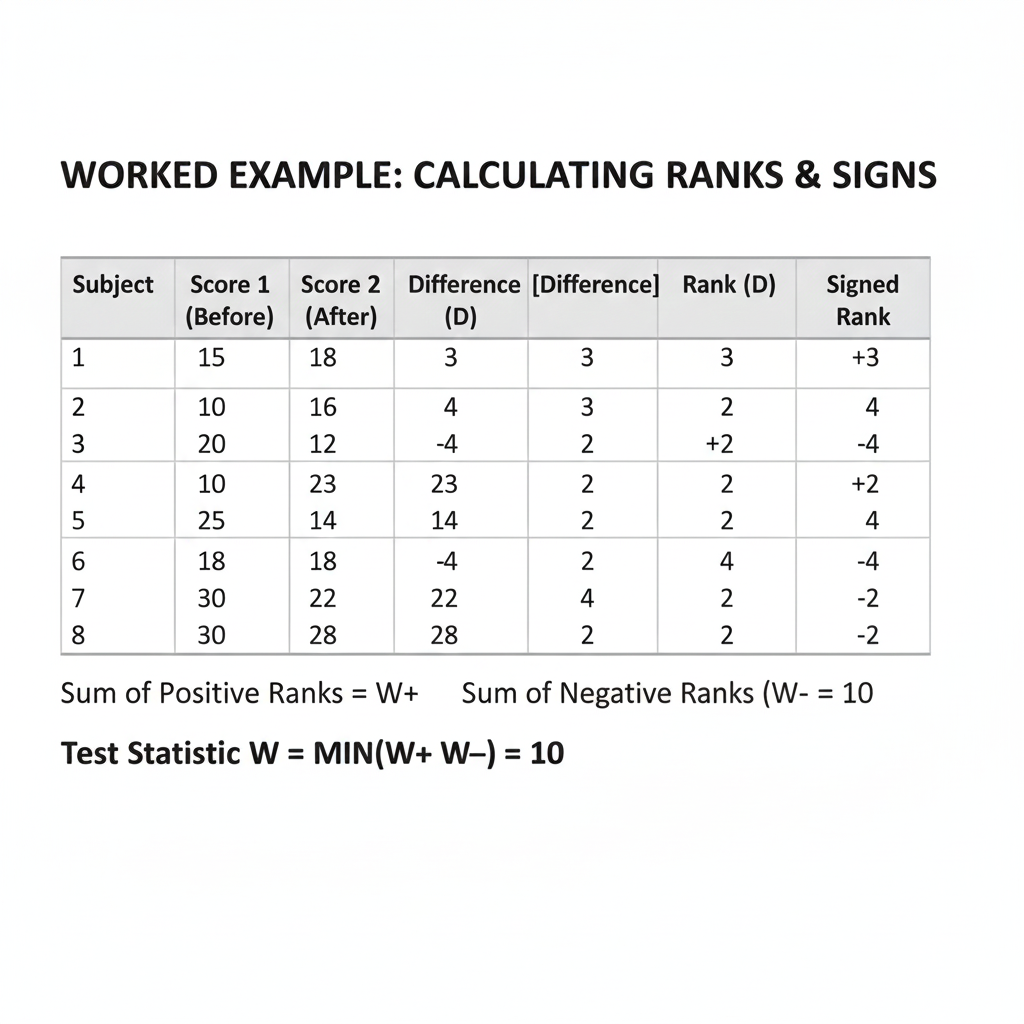
Step 4: Rank Absolute Differences
Rank the absolute values of differences from smallest to largest.
Step 5: Assign Signs
Attach positive or negative signs based on the original direction of difference.
Step 6: Sum the Ranks
Calculate:
- Sum of positive ranks (W⁺)
- Sum of negative ranks (W⁻)
Step 7: Test Statistic
The smaller of W⁺ or W⁻ is used as the test statistic.
Example of Wilcoxon Signed-Rank Test in Biostatistics
Example Scenario
A researcher measures systolic blood pressure in 10 patients before and after administering a new drug.
| Patient | Before | After | Difference | Rank | Sign |
| 1 | 140 | 132 | -8 | 6 | − |
| 2 | 150 | 142 | -8 | 6 | − |
| 3 | 138 | 130 | -8 | 6 | − |
| 4 | 145 | 140 | -5 | 4 | − |
| 5 | 142 | 135 | -7 | 5 | − |
After ranking and summing signed ranks, the calculated test statistic is compared with the critical value or p-value.
Interpretation of Results
- p ≤ 0.05: Reject the null hypothesis (significant difference exists)
- p > 0.05: Fail to reject the null hypothesis (no significant difference)
Reporting Example
“The Wilcoxon Signed-Rank Test indicated a statistically significant reduction in blood pressure after treatment (p < 0.05).”
Advantages of the Wilcoxon Signed-Rank Test
- No requirement of normal distribution
- Suitable for small sample sizes
- Robust against outliers
- Applicable to ordinal data
- Easy to interpret
Limitations of the Wilcoxon Signed-Rank Test
- Less powerful than paired t-test when normality holds
- Assumes symmetry of differences
- Cannot be used for independent samples
Applications in Biostatistics and Life Sciences
- Clinical trials and medical studies
- Pharmacological experiments
- Ecology and environmental studies
- Agricultural field experiments
- Behavioral and psychological research

Conclusion
The Wilcoxon Signed-Rank Test is a powerful and versatile non-parametric statistical tool in biostatistics. It provides a reliable alternative to the paired t-test when data violate normality assumptions. By ranking differences rather than using raw values, the test offers robustness and flexibility for real-world biological data. Understanding when and how to apply the Wilcoxon Signed-Rank Test enables researchers and students to make accurate inferences from paired observations, strengthening the quality of scientific conclusions.