Introduction
Biostatistics plays a vital role in understanding health-related data, medical research, and biological phenomena. One of the most fundamental concepts in biostatistics is the idea of variables, particularly independent variables. These variables serve as the foundation for designing experiments, conducting statistical analysis, and interpreting results in biomedical research.
Independent variables help researchers identify causes, predict outcomes, and evaluate relationships between different biological factors. Whether studying disease risk factors, treatment effects, or population health trends, understanding independent variables is essential for accurate and meaningful conclusions.
This article provides a comprehensive explanation of independent variables in biostatistics, including definitions, concepts, step-by-step explanations, examples, and their importance in research.
Definition of Independent Variables
An independent variable is a variable that is manipulated, controlled, or selected by the researcher to observe its effect on another variable, known as the dependent variable.
In simple terms:
Independent Variable = Cause or Predictor
Dependent Variable = Effect or Outcome
For example, in a study analyzing the effect of smoking on lung disease:
- Smoking status → Independent Variable
- Lung disease occurrence → Dependent Variable
Concept of Independent Variables in Biostatistics
Independent variables are central to statistical modeling and experimental design. They represent factors that may influence biological or health outcomes.
Key Characteristics
- Controlled or Selected by Researcher
Researchers decide the levels or categories of independent variables. - Not Affected by Other Variables in the Study
They act as inputs rather than outcomes. - Used for Prediction
They help explain or predict changes in dependent variables. - Can Be Quantitative or Qualitative
- Quantitative: Age, blood pressure, weight
- Qualitative: Gender, treatment group, smoking status
Types of Independent Variables
1. Continuous Variables
These variables can take any numerical value within a range.
Examples:
- Age
- Blood sugar level
- Cholesterol level
2. Categorical Variables
These variables represent categories or groups.
Examples:
- Gender (Male/Female)
- Smoking status (Yes/No)
- Treatment type (Drug A, Drug B, Placebo)
3. Binary Variables
A special type of categorical variable with only two categories.
Examples:
- Disease presence (Yes/No)
- Survival (Alive/Dead)
4. Ordinal Variables
Variables with ordered categories.
Examples:
- Pain level (Mild, Moderate, Severe)
- Disease stage (Stage I, II, III, IV)
Step-by-Step Explanation of Independent Variables
Step 1: Identify the Research Problem
The first step is to clearly define the research question.
Example:
Does exercise reduce blood pressure?
Step 2: Identify Variables
- Independent Variable: Exercise duration
- Dependent Variable: Blood pressure
Step 3: Classify the Independent Variable
Determine the type:
- Continuous → Exercise duration (minutes/day)
Step 4: Define Measurement Method
Specify how the variable will be measured:
- Exercise: Minutes per day
- Frequency: Days per week
Step 5: Control or Manipulate Variable
In experimental studies, researchers control the independent variable.
Example:
- Group A: 30 minutes exercise
- Group B: No exercise
Step 6: Analyze Relationship
Use statistical methods such as:
- Regression analysis
- ANOVA
- Correlation
Step 7: Interpret Results
Determine whether the independent variable significantly affects the outcome.
Importance of Independent Variables in Biostatistics
1. Helps Establish Cause-and-Effect Relationships
Independent variables allow researchers to test hypotheses and determine whether one factor influences another.
2. Essential for Statistical Models
Used in:
- Linear regression
- Logistic regression
- Survival analysis
3. Improves Research Accuracy
Proper identification of independent variables reduces bias and improves reliability.
4. Supports Public Health Decisions
Helps identify risk factors and develop interventions.
Examples of Independent Variables in Biostatistics
Example 1: Clinical Trial
Study: Effect of a new drug on diabetes
- Independent Variable: Drug dosage
- Dependent Variable: Blood glucose level
Example 2: Epidemiological Study
Study: Impact of smoking on lung cancer
- Independent Variable: Smoking status
- Dependent Variable: Lung cancer incidence
Example 3: Nutritional Study
Study: Effect of diet on body weight
- Independent Variable: Calorie intake
- Dependent Variable: Body weight
Example 4: Public Health Study
Study: Effect of vaccination on disease prevention
- Independent Variable: Vaccination status
- Dependent Variable: Disease occurrence
Independent vs Dependent Variables
| Feature | Independent Variable | Dependent Variable |
|---|---|---|
| Role | Cause | Effect |
| Control | Controlled by researcher | Observed outcome |
| Example | Drug dosage | Blood pressure |
| Nature | Predictor | Response |
Common Mistakes in Identifying Independent Variables
1. Confusing Independent and Dependent Variables
Always ask: Which variable influences the other?
2. Ignoring Confounding Variables
Other variables may affect the outcome.
Example:
Age can influence both exercise and blood pressure.
3. Improper Measurement
Using inaccurate tools or inconsistent methods.
4. Overloading with Too Many Variables
Including too many independent variables can complicate analysis.
Role of Independent Variables in Statistical Analysis
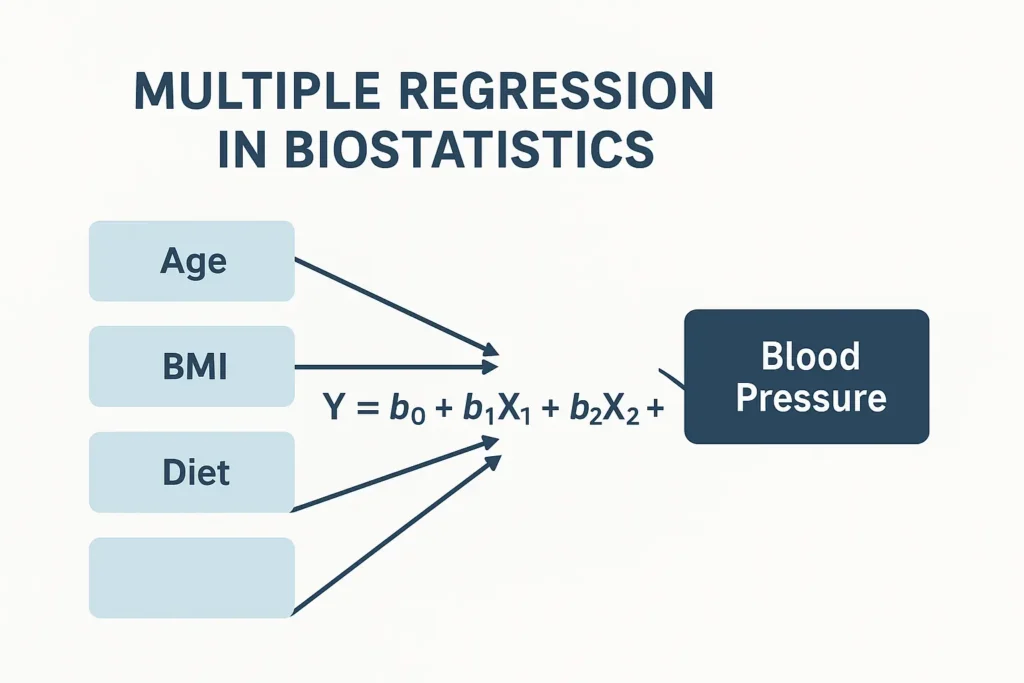
1. Regression Analysis
Independent variables are used to predict outcomes.
Example:
Blood pressure = f(age, weight, exercise)
2. ANOVA (Analysis of Variance)
Used to compare means across groups defined by independent variables.
3. Logistic Regression
Used when the dependent variable is binary.
4. Survival Analysis
Independent variables help analyze time-to-event data.
Real-Life Application in Biostatistics
Independent variables are widely used in:
- Clinical trials
- Disease risk analysis
- Drug development
- Health surveys
- Epidemiological studies
They help researchers:
- Identify risk factors
- Evaluate treatments
- Predict outcomes
Conclusion
Independent variables are a cornerstone of biostatistics and play a crucial role in research design, data analysis, and interpretation. They act as predictors or causes that influence outcomes, enabling researchers to establish relationships between different biological and health-related factors.
Understanding independent variables helps in building accurate statistical models, minimizing errors, and making informed decisions in healthcare and public health. Whether in clinical trials, epidemiological studies, or experimental research, the proper identification and use of independent variables ensure reliable and meaningful results.
In summary, mastering the concept of independent variables is essential for anyone involved in biostatistics, as it forms the foundation for scientific investigation and evidence-based practice.